Well we have just completed the busiest weekend we have had at Hadleys since I started in late April. We fed just over 500 people from Friday - Sunday night just in functions. Then we had the restaurant, room service and around 130 people in for high teas so it was all go. Friday night was the big one with 3 dinners and a cocktail party. I take my hat off to my team and the front of house team as the whole weekend went very well. All functions were well organized and ran very smoothly. The temp staff we had in from our sister hotel and a local polytechnic worked very well. It is such a buzz when you have a big day, or in this case a big weekend, when everything just clicks and you can stand back at the end of the night and say that there was nothing I could have done to make this go any smoother. It has been a long 3 months but we have Hadleys pointing in the right direction now so we are looking forward to a busy lead up to Christmas. And not to forget that little thing of opening Hadleys Collins Street as well. We are in the final stages of planning the fit outs for both front and back of house. Busy designing the kitchen and food outlets, getting quotes and the other 100 thing that come with opening a new outlet.
We are adding some more staff to our teams now as demand grows and this is allowing me to spend the time required to manage what we are doing and giving me the time to plan where we want to be. We have had 2 groups of hospitality students come in for a behind the scenes look at how a hotel works from a local polytechnic this week. The 2 groups were divided into 2 sections those that want to work front of house and those that want to work, of course where all the fun is, in the kitchen. So I met with them first and gave them a look around and a brief lesson on what we do at Hadleys and what we will be doing with the new development. Then showed them through the kitchen were they got to see what a kitchen looks like after a busy breakfast and lunch service. Also this gave them the chance to ask any questions they wanted. It was a good intro for them and also gave us a sneak peek at those students who were serious about making hospitality their career.
One of the questions that I was asked was " what are the benefits of being a chef " for me this is an easy question to answer. For one if you apply yourself you can always get a job, you can travel at home and abroad and you will get out of this industry what you put in and it can take you far indeed. I will be traveling to China and Japan in a few weeks to organize some purchases and see a few concepts that we want to implement in the new development. And for me being given the chance to do this is one of the best perks about my job. I would like to thank the owner of Hadleys for putting his trust in me and giving me the chance to be so involved in what is going to be a fantastic development. So I will be having a ball with any free time I get in China and eating as much street food as I can and taking as many photos as I can for my blog. Tokyo fish markets here I come, I do not care what time I have to get up I can sleep on the plane on the way back. I have a shopping list a mile long and my staff keep adding to it on a daily basis. As long as I have enough room left for a knife or two for me and something nice for Mrs Chef then all is good.
I have added a new page to my blog called ask the chef. Now I do not want to sound like a know it all but if you have any culinary questions then just ask and we will see what we can do. Also lets swap and share recipes, photos and dinning experiences. I am very keen to get some old recipes for sauces, jams, chutney and relishes. And any recipes for hams, salami and meat curing in general, especially prosciutto as this is something that I have wanted to do for a long time. This page is for general information and the sharing of knowledge so lets give it a go and have some fun with it. I was asked not so long ago why I shared some of my so called chef secrets. Well as far as I am concerned food is about sharing and not just the dinning experience. I like to know the story behind the products that I am using and I like to pass this on to my team and guests as well. This gives everyone a greater understanding of what and why I use some of the products that I use and also gets the name of some of my producers and products out there as well. Some one may eat at Hadleys and in a few months be somewhere else and recognize a name of a supplier or product and remember that they enjoyed it and try it again. Then it is win win for everyone from the producer to the customer. If someone asks me how or why I use something or how do I do that then I will always pass on the information.
By the way the cheese is going nicely it has a good layer of white mould growing on it and it starting to ripen from the outside in. We could not resist and tried some last night great taste still developing and a bit chalky inside but on the way. I will post some photos of the cheese soon. Can not wait for China and Japan.

One chefs return home and adventures rediscovering the culinary delights of Tasmania.
Tuesday, July 27, 2010


Saturday, July 17, 2010
Cheese nothing but the cheese, make mine raw milk please.
Saturday the 11th July Mrs Chef and I had the chance to do something that we have wanted to do for a long time make our own cheese. The day was run by Nick Haddow of Bruny Island Cheese and what a day it was. We started out with some theory about cheese making to give us an understanding of what we were about to make and the various steps along the way and what was happening to the cheese.
Because we were making this cheese for our own consumption we were given the choice of using raw or pasteurised milk. Of course we jumped at the chance to use the raw milk so we could get the full flavor of the milk into our cheese. The debate about raw milk will have to wait for another post. We started by heating the milk to 35 c and placing the pot into a sink of warm water to maintain the temperature.
 The next step was to add the starter culture and sir well every few minutes for the next 45 minutes. All the while keeping an eye on the temperature. Nick is a very good teacher and spent a lot of time ensuring we new what we were doing and answering our many questions.

After the 45 minutes we added the rennet and mixed well to set the curd. A process that would take around 40-50 minutes. During this time Nick kept us busy getting ready for the next steps and entertaining us with stories of his travels to make cheese in Europe
and again answering questions.

Now the fun really starts testing the curds. At this stage you gently put your fingers into the curd at an angle and gently lift up. What you are looking for is the curd to split as in the photo on the left. When you see this you know the curd is ready for cutting.

Cutting the curd. You are supposed to gently cut the curd into even walnut size pieces, not so easy to do with a knife in a pot. You cut in one direction then the other until you have cut the curd in a criss cross pattern. Then you cut the same way from top to bottom, we ended up with some strange looking walnut pieces. You cut the curd to help release the whey. At this stage the curds are very delicate so you let them rest for 30 minutes before you start stirring the curds.

Stirring the curds. During this process you gently stir the curds by hand this allows you to gently break up any large pieces and by stirring this helps expel the whey. You do this every few minutes for about 30 minutes. during this time the curds are gradually firming up and more why is released. Then you allow the curds to settle and the whey to release you should have in your pot about 50/50 curds and whey.

 Hooping time once the curds have settled you drain off some of the whey and then scoop the curds into the groovy little moulds called hoops. You need to fill the hoops to the max because as the whey drains out the curds compress and you will end up with a cheese half the size from when you started.
The finished cheese in the hoops draining once they have sat for about 10 minutes you need to turn them in the hoops. It was at this stage that Nick casually eased a cheese out of the hoop tossed it up in the air and caught it one handed and deftly placed it back into the hoop a process that took Nick around 5 seconds. For us it would take longer with mixed results. Until Mrs Chef took a spare hoop and placed it on top of the filled hoop and just turned them up the other way. A technique that soon caught on with those that were sharing our bench. But I still had to give the one handed tip, toss, catch and stuff routine a go. But I will admit with mixed results. The cheese had to be turned 5 times over the next few hours to assist in the draining of the whey. The hoops are placed on to a black cheese mat and this is placed onto a cake rack and placed into a plastic storage box with a lid and this box would become our maturation chamber. So there we have it our cheese made, hooped and stored but what to do with all that whey, well I am glad you asked we make fresh ricotta with it.
 This is a very old practice born out of necessity to utilise all that you can from a product and not waste anything. Just about all ricotta that you can buy is made from milk these days and not whey which is the traditional way to make ricotta. It is such a simple process the whey is heated to 60 c then salt is added. The whey is then heated to 90 c and some vinegar is added. The ricotta forms almost immediately on top of the whey. The ricotta is then scooped off and is ready to eat. Let me tell you that warm fresh ricotta is so far removed from what you buy in the shop it was fantastic.
So there you have it our fantastic cheese day spent with Nick making our own little cheeses. If you have ever want to give this a go I can highly recommend it as you will have a great day and some good cheese. To be able to spend the day with someone as passionate about their craft as Nick is a wonderful experience. Nick pointed us to a few web sites if we wanted to continue our cheese making endeavors.
We are hoping that Nick will increase his classes and enable us to do more courses. Once we got our cheese home we had to continue turning them and letting them drain. The next day the cheese is taken out of the hoops and we placed them into a salt brine for 45 minutes then back into the cleaned and sterlised maturation chamber. We have to turn the cheese once every day and we should start to see the white mould growing on them around day five. The cheese is ready to wrap in waxed wrap around day 10 then matured as we like. We marinated 1 of the cheeses after the first day in EVO and herbs to eat as a fresh curd and it was delicious. I will post more photos of our cheese as they mature.
Because we were making this cheese for our own consumption we were given the choice of using raw or pasteurised milk. Of course we jumped at the chance to use the raw milk so we could get the full flavor of the milk into our cheese. The debate about raw milk will have to wait for another post. We started by heating the milk to 35 c and placing the pot into a sink of warm water to maintain the temperature.


After the 45 minutes we added the rennet and mixed well to set the curd. A process that would take around 40-50 minutes. During this time Nick kept us busy getting ready for the next steps and entertaining us with stories of his travels to make cheese in Europe
and again answering questions.

Now the fun really starts testing the curds. At this stage you gently put your fingers into the curd at an angle and gently lift up. What you are looking for is the curd to split as in the photo on the left. When you see this you know the curd is ready for cutting.

Cutting the curd. You are supposed to gently cut the curd into even walnut size pieces, not so easy to do with a knife in a pot. You cut in one direction then the other until you have cut the curd in a criss cross pattern. Then you cut the same way from top to bottom, we ended up with some strange looking walnut pieces. You cut the curd to help release the whey. At this stage the curds are very delicate so you let them rest for 30 minutes before you start stirring the curds.

Stirring the curds. During this process you gently stir the curds by hand this allows you to gently break up any large pieces and by stirring this helps expel the whey. You do this every few minutes for about 30 minutes. during this time the curds are gradually firming up and more why is released. Then you allow the curds to settle and the whey to release you should have in your pot about 50/50 curds and whey.

 Hooping time once the curds have settled you drain off some of the whey and then scoop the curds into the groovy little moulds called hoops. You need to fill the hoops to the max because as the whey drains out the curds compress and you will end up with a cheese half the size from when you started.
 The finished cheese in the hoops draining once they have sat for about 10 minutes you need to turn them in the hoops. It was at this stage that Nick casually eased a cheese out of the hoop tossed it up in the air and caught it one handed and deftly placed it back into the hoop a process that took Nick around 5 seconds. For us it would take longer with mixed results. Until Mrs Chef took a spare hoop and placed it on top of the filled hoop and just turned them up the other way. A technique that soon caught on with those that were sharing our bench. But I still had to give the one handed tip, toss, catch and stuff routine a go. But I will admit with mixed results. The cheese had to be turned 5 times over the next few hours to assist in the draining of the whey. The hoops are placed on to a black cheese mat and this is placed onto a cake rack and placed into a plastic storage box with a lid and this box would become our maturation chamber. So there we have it our cheese made, hooped and stored but what to do with all that whey, well I am glad you asked we make fresh ricotta with it.
 This is a very old practice born out of necessity to utilise all that you can from a product and not waste anything. Just about all ricotta that you can buy is made from milk these days and not whey which is the traditional way to make ricotta. It is such a simple process the whey is heated to 60 c then salt is added. The whey is then heated to 90 c and some vinegar is added. The ricotta forms almost immediately on top of the whey. The ricotta is then scooped off and is ready to eat. Let me tell you that warm fresh ricotta is so far removed from what you buy in the shop it was fantastic.
 So there you have it our fantastic cheese day spent with Nick making our own little cheeses. If you have ever want to give this a go I can highly recommend it as you will have a great day and some good cheese. To be able to spend the day with someone as passionate about their craft as Nick is a wonderful experience. Nick pointed us to a few web sites if we wanted to continue our cheese making endeavors.
We are hoping that Nick will increase his classes and enable us to do more courses. Once we got our cheese home we had to continue turning them and letting them drain. The next day the cheese is taken out of the hoops and we placed them into a salt brine for 45 minutes then back into the cleaned and sterlised maturation chamber. We have to turn the cheese once every day and we should start to see the white mould growing on them around day five. The cheese is ready to wrap in waxed wrap around day 10 then matured as we like. We marinated 1 of the cheeses after the first day in EVO and herbs to eat as a fresh curd and it was delicious. I will post more photos of our cheese as they mature.
Sunday, July 11, 2010
Well it is about time that I updated my blog. It has been a while and I have done a fair bit since my last post so this may have to be over two posts. So first up I have taken up the Executive Chefs position at Hadleys and have been hard at work there since April 26th. What attracted me to Hadleys, apart from being back in Hobart with Mrs Chef, is what Hadleys once was and is going to be again. I am part of a new management team that has been charged with resurrecting Hadleys and making Hobart fall in love with Hadleys once again. Also we have been charged with the opening of the new Hadleys Collins street development. look out Hobart Hadleys is coming back and is going to have something for everyone. Hadleys Murray street will continue with our restaurant, high teas, conference and function rooms. While Hadleys Collins street will add around another 130 rooms more conference and function rooms another restaurant with a huge wood fired Argentine grill, boy am I looking forward to getting my hands on that grill. Wood, fire and meat does it get any better than that not to mention the seafood that I can grill on that bad boy.
The old stables will become a fantastic function room perfect for intimate weddings. We will also have a Complete Gourmet deli stocking all your favorite deli lines as well as a range of ready to go take home meals for you to finish at home. At the other end of the deli will be a cafe with boxed lunches to go for the office worker on a time line. And out side in the glass covered court yard will be our wood fired pizza area. So with two restaurants, multiple function rooms, over 200 rooms, deli, cafe, pizza area, conference and weddings I am going to be a busy chef, but what a buzz getting all this sorted. I am lucky to have been given the chance to design and fit out the kitchens and it will be nice to work in a space designed for chefs with things where they are supposed to be.
Ok food wise the first two months were spent getting the kitchen into some sort of shape and getting to know my new team and work out what level they were at. I am very pleased to say that the team are very keen and eager to learn and have embraced all that we are striving to achieve. That is not to say that we have not made a few mistakes in the first few months but each one has been learning experience for the team. We are not trying to reinvent the wheel just give it a bit of a polish. Nor are we trying to be the best 5 star restaurant in town. But we do want to be producing good food and our first menu is a good training ground for the team. So look forward to bigger and better things.
As far as food adventures go I have not had a lot of time to get out there yet but I have been to Bruny Island Cheese, and did not want leave the cheese room. Never miss the farmers market Sunday mornings. We spent the day yesterday with Nick from Bruny Island Cheese making cheese, something that we have been wanting to do for a while, and what a day it was. I will post the photos on the next post and updates on how the cheese is maturing over the next two weeks.
The old stables will become a fantastic function room perfect for intimate weddings. We will also have a Complete Gourmet deli stocking all your favorite deli lines as well as a range of ready to go take home meals for you to finish at home. At the other end of the deli will be a cafe with boxed lunches to go for the office worker on a time line. And out side in the glass covered court yard will be our wood fired pizza area. So with two restaurants, multiple function rooms, over 200 rooms, deli, cafe, pizza area, conference and weddings I am going to be a busy chef, but what a buzz getting all this sorted. I am lucky to have been given the chance to design and fit out the kitchens and it will be nice to work in a space designed for chefs with things where they are supposed to be.
Ok food wise the first two months were spent getting the kitchen into some sort of shape and getting to know my new team and work out what level they were at. I am very pleased to say that the team are very keen and eager to learn and have embraced all that we are striving to achieve. That is not to say that we have not made a few mistakes in the first few months but each one has been learning experience for the team. We are not trying to reinvent the wheel just give it a bit of a polish. Nor are we trying to be the best 5 star restaurant in town. But we do want to be producing good food and our first menu is a good training ground for the team. So look forward to bigger and better things.
As far as food adventures go I have not had a lot of time to get out there yet but I have been to Bruny Island Cheese, and did not want leave the cheese room. Never miss the farmers market Sunday mornings. We spent the day yesterday with Nick from Bruny Island Cheese making cheese, something that we have been wanting to do for a while, and what a day it was. I will post the photos on the next post and updates on how the cheese is maturing over the next two weeks.
Sunday, April 25, 2010
I have been at Cradle Mountain Lodge for a few weeks shy of 12 months and sadly it is time to move on. I have loved my time at the Lodge and I have been able to do some fantastic work and use some stellar ingredients. Mrs Chef and I made the decision to move back home to Tasmania early 2009 and set about making this happen. The position at the Lodge came up almost immediately and four weeks latter there I was on Cradle Mountain in the second week of May with my trusty scooter with the first real winter I had lived through in quite a few years on the way, the second Saturday we had the first snow fall for that year. Coming from Brisbane it was a bit of a shock but all part of the adventure. The plan was for me to come down and Mrs Chef to follow when a transfer to Tasmania became available. Our children were going to stay in our Brisbane home while they both finished uni. The move for Mrs Chef did not happen until September 2009 and when it did it soon became apparent that Mrs chef would have to be in Hobart due to family necessity and I would be on Cradle Mountain and come down on my days off. At the time we knew what this would entail and our plan was to do this for a few years then I would move back to Hobart or the Huon Valley where I grew up get a bit of land grow and produce some of our own food and work in Hobart. However by March 2010 we realized that this was not giving us the quality of life that we moved back to Tasmania to achieve. As much as I love the work we do at the Lodge it is time to make a move. I have had the privilege of working with some fantastic and talented chefs in my time here and we have done some fantastic events and dinners and lets not forget the road trips to meet our suppliers and producers. By far the most popular was the truffle road trip, see previous post. So a big thank you goes to Thomas, I still have the photos of you and Larry the lamb, Jimmy solid as a rock and ever dependable I hope things are going well in WA, Miss Nadia and miss Megan you are two of the best chefs I have worked with and made going to work a lot of fun I will miss being one of the girls. I wish you all the best Nadia for you on Heron Island then Canada and Megan have a great time in the UK. Brother Ferdie one of the original road trippers and also one of the best chefs I have worked with keep getting amongst it big fella, thanks for the cob I used it the first Sunday night I was in Hobart fantastic and now I am hooked. Mike almost always the first one to start I thank you for your efforts and you did very well on all sections, Stephen the most energetic young chef I have worked with keep it up and I have no doubt that you can go as far as you want, Kevin I am glad I took the chance on you as a first year apprentice you have come a long way in your time at the Lodge keep up the good work.Suzie, Gemma and all of the floor team well done it has been a pleasure working with you. Trevor the best breakfast chef you took the worry of breakfast away from me giving me one less thing to worry about, Steve B you have been great being thrown in as steward, breakfast cook and in the tavern. The stewards Simon, Jason, Shannon and Sheryl you had the worst job at times but you did it well. Leigh the GM thanks for letting me be a part of the Lodge team, Meagan in HR thanks for all your help during my stay. Also thank you to Steve, Troy, Jezza, Ossie, Beth and everyone else who works at the lodge. It has been a great year and one that will remain with me for a long time. To all chefs out there if you ever get the chance to work at Cradle Mountain Lodge take it as you will get the chance to do some fantastic work and use some fantastic product. I would recommend the Lodge as a great place to work for anyone.
Now while at the Lodge I had the pleasure of meeting some fantastic producers and use their products in my menus. So a big thank you for sharing your knowledge with me and my chefs goes out to, in no particular order, Guy and Eliza from Mount Gnomon Farm for your stunning free range Wessex Saddle Back pork, Brian and Jan Bonde for your beautiful Wild Clover Lamb one of the most popular items on our menu, Jim and Marilyn from Springfield Deer Farm your venison is superb and also one of the most popular menu items, Steve and Ellice from Tasfresh thanks for putting up with all the questions, all of the team at Petuna, PFD, Spreyton butchery, Tim Terry for your magical truffles and the best road trip we had and any one else that I may have forgotten. You have all made it a year to remember.
So I am back in Hobart after an absence of some 20 odd years and very much looking forward to the challenge of what I am taking on next - more on that in my next post - I love being in Hobart and the fact that it is so easy to get around and takes no time to get anywhere. The other day I took the scooter out for a spin as it was a very nice day and ended up having fish and chips for lunch on the banks of the Huon river in my old home town of Huonville. A trip that took only half the time it took me to get off the mountain. Saturday after a 10 minute shopping trip we had 3 kg of mussels from Mures, wine and salad for dinner and all the ingredients for another baked egg breakfast extravaganza. Love Hill Street Grocer. I am looking forward to getting out there and meeting suppliers and producers at this end of the state and going on road trips with my new team. Ok that is all for now more soon and look out for the blue scooter on the streets of Hobart.
Now while at the Lodge I had the pleasure of meeting some fantastic producers and use their products in my menus. So a big thank you for sharing your knowledge with me and my chefs goes out to, in no particular order, Guy and Eliza from Mount Gnomon Farm for your stunning free range Wessex Saddle Back pork, Brian and Jan Bonde for your beautiful Wild Clover Lamb one of the most popular items on our menu, Jim and Marilyn from Springfield Deer Farm your venison is superb and also one of the most popular menu items, Steve and Ellice from Tasfresh thanks for putting up with all the questions, all of the team at Petuna, PFD, Spreyton butchery, Tim Terry for your magical truffles and the best road trip we had and any one else that I may have forgotten. You have all made it a year to remember.
So I am back in Hobart after an absence of some 20 odd years and very much looking forward to the challenge of what I am taking on next - more on that in my next post - I love being in Hobart and the fact that it is so easy to get around and takes no time to get anywhere. The other day I took the scooter out for a spin as it was a very nice day and ended up having fish and chips for lunch on the banks of the Huon river in my old home town of Huonville. A trip that took only half the time it took me to get off the mountain. Saturday after a 10 minute shopping trip we had 3 kg of mussels from Mures, wine and salad for dinner and all the ingredients for another baked egg breakfast extravaganza. Love Hill Street Grocer. I am looking forward to getting out there and meeting suppliers and producers at this end of the state and going on road trips with my new team. Ok that is all for now more soon and look out for the blue scooter on the streets of Hobart.
Monday, April 19, 2010
black magic

When is a nut more than a nut ? well I am glad you asked. This is a question I asked my chefs on a recent very cold, wet and windy Monday morning as I loaded them onto a bus at the very unchef like hour of 5.30 am. Not surprisingly this was met with a chorus of moans, groans and mumbles. Ok the answer to the question is when you can use the humble little acorn to produce one of the worlds most prized and expensive ingredients the black truffle.

We were lucky enough to get a tour of Tim Terry's truffle farm at Mole Creek and it was the best road trip to a producer that I have been on. We met Tim at his property around 7.00 am, well maybe 7.15 am after I stopped stalling the bus and got it out of the hedge I had backed into, sorry boss. The tour started at the nursery where Tim explained the process to us in great detail but in a way that all of us could understand. I thought I had a good understanding of how truffles are produced, boy was I wrong, The acorns are germinated and after a while the root system is inoculated with the truffle fungus. This fungus then grows on the root system and looks like tiny little fingers branching off the roots of the plant. The truffles actually form on the ends of these fingers and not on the root system as I had thought.
The first photo on the right is of Tim showing
us the fingers of the truffle fungus
that is growing on the root system. It was too fine to show up in a photo but clearly visible to the naked eye. The second photo shows a portion of the juvenile trees that have been inoculated.

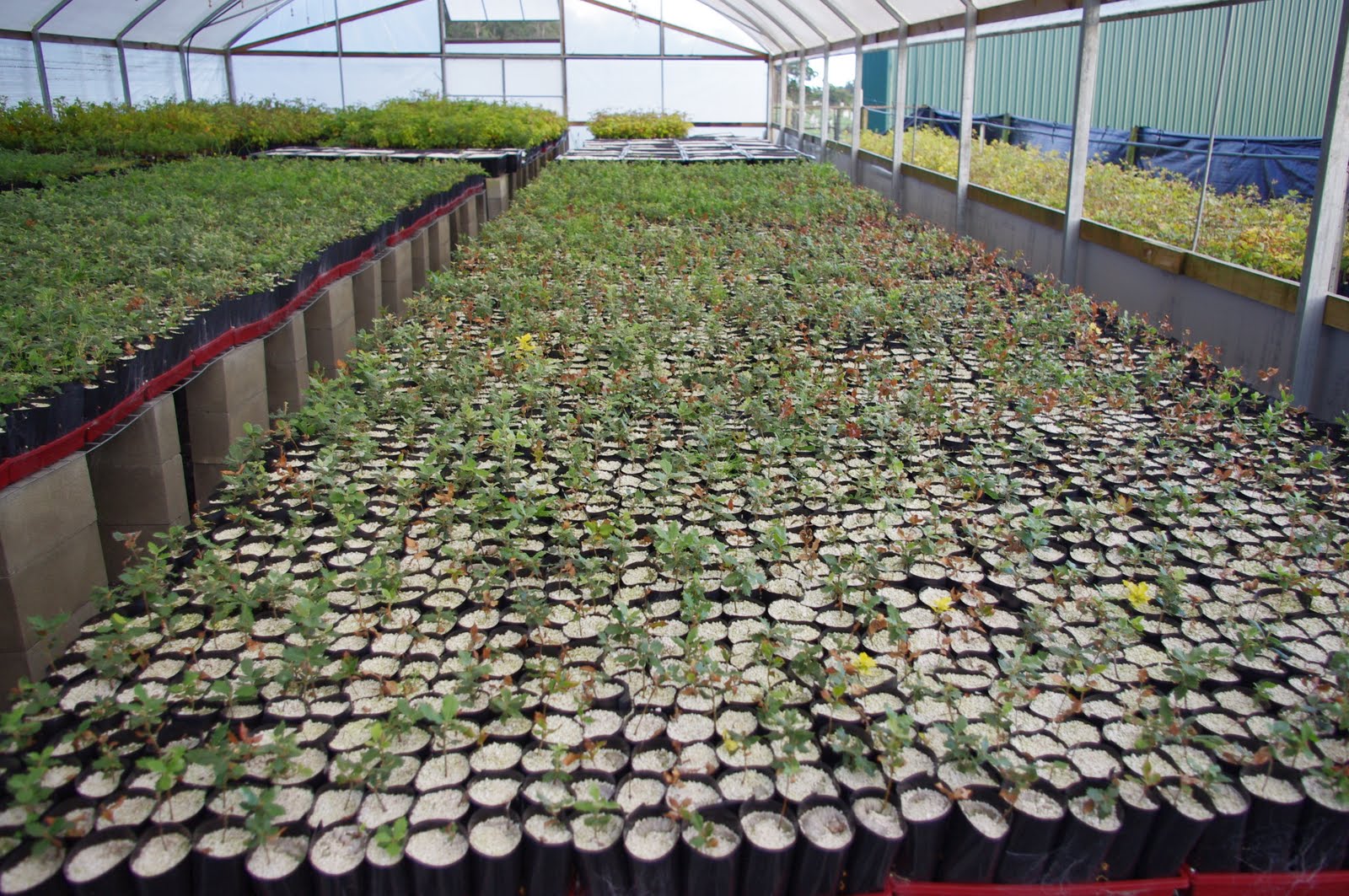 The trees will stay in
the nursery until they mature enough to be planted out. There is
a lot that goes into the soil preparation to get the right balance
for optimum growing conditions. . According to Tim it has been an ongoing process of trial and error, research and trips to Europe to work with truffle producers and then adapt the process to Tasmanian conditions. Also a matter of trial and error with what trees are best suited, whether to produce just winter or just summer truffles or both. Go just for black or try for the holy grail of truffles the white. And thousands of other things to overcome when at the start everyone told Tim that it cannot be done in Tasmania. I for one am very glad that Tim did not listen to they nay sayers and went ahead to become the pioneer of the truffle industry in Australia. Any way back to the tour. After the nursery and answering all of our questions we went into the fields to get a first hand look.
We saw the original hazelnut trees and then the oak trees, and even a grove of poplar trees that Tim is hoping to harvest his first white truffles from this winter. And at a value of around $7000 a kilo I would be hoping as well. We walked among the oak trees as Tim explained what we were looking at and how the truffles grow and are harvested. Under the trees the ground is bare with nothing growing not even weeds and this is caused by the truffle fungus and is called the brulee as in creme brulee this means burnt or scorched. As the trees grow this brulee expands as well and one benefit from this is it cuts down on weeding so saves money on labor. Within seconds Tim was pointing and saying there is a truffle and another and another. Once Tim explained what he was seeing we soon started finding them as well and they were everywhere. Tim explained that if we were to dig up these truffles now they would be bright orange and have no scent as they were just beginning to grow. This bit of news put paid to the idea of filling our pockets with truffles that some of my chefs had. These truffles are going to be this years winter truffle harvest. At this stage as the truffle is growing it actually breaks the ground above it and you can see the cracks and mounds in the ground quite clearly.


Far left you can see the brulee under the trees. Near left you can see the ground breaking over a truffle. Once we knew what to look for we found them by the hundreds so this years harvest is looking good can not wait to use them.
We have used Tim's winter black truffles at the Lodge for our Tastings At The Top event last June and for a few dinners that winter as well. All I can say is amazing if you ever get the chance to try some of Tim's truffles you will not be disappointed. The winter truffles are by far stronger in scent and flavor than the summer truffles and this is reflected in the price $2000 per kilo for winter and $800 per kilo for the summer. This is not to say the summer truffles are no good it is just that the season for the truffles is winter. And as with any produce it is always best in season.
The truffle in the second photo I brought to Hobart with me on my next days off to share with Mrs chef and it was fantastic. The first thing I did was to store the truffle in an airtight container with 1 dozen free range eggs from the Sunday farmers market and let this stand over night. Then I placed some Wessex saddle back ham from Mount Gnomon Farm into a small ceramic dish grated some of the black truffle onto this. Cracked two eggs into the dish added a splash of cream some more grated truffle a grind of pepper and a bit of sea salt and baked it in the oven for about 10 minutes or until the eggs are cooked to your liking. Fried up some of the Wessex saddle back bacon, sliced up some sourdough bread and there you have a breakfast that simply defies words. The flavors were so intense the truffle coming through beautifully.
This road trip was outstanding and all of my chefs got a lot out of it and enjoyed the day immensely. I would like to thank Tim for his time and patience and say that my hat is off to him for the work he is doing and I look forward to using his truffles in the future. As a chef it is fantastic to have Tim producing his truffles here in Tasmania. Yes the price per kilo is high but there is a lot of truffle in a kilo and you can get a decent size piece for home for around $50.00 depending on season. Tim can send fresh truffles throughout Australia in 24 hours and into Europe in 24 - 48 hours. I will place a link for Tim's truffles in the link section of my blog. The packaging Tim uses is excellent and the truffles arrive to you as good as they were when dug up.
Tuesday, April 6, 2010
 This is the shima wasabi stem on the right and a small grater on the left also supplied by shima wasabi. The wasabi is the stem and not the root of the plant as some think it is. You grate the wasabi by grinding it in a circular motion on the grater until a paste is formed. Stephen from shima wasabi explained it best to me and this is how I explain the process to our guests. The wasabi needs to ground on this board to release its full flavor and strength similar to how an epoxy glue needs to be mixed together to work, so does the wasabi. You can grate the wasabi on a grater or micro plane but you will not get the full benefit of the wasabi and the taste will be nothing like it should be. The paste when you grind it can vary from a light green to grey in color nothing like the wasabi you get in the tubes on dried in the tins. All this is is horseradish and green food color. And for years that is what most of us have known as wasabi. I discovered shima wasabi in my first week at the lodge when I found a random box of funny looking leaves in the cool room, the first two weeks in a new kitchen are always fun as you can discover some unusual things some good some not. Anyway I asked what these were and what do we use them for and was told that a previous chef had got them in for something and this is what was left. So I tasted some and was very impressed with the flavor and after a bit of digging around in the box I found a packing slip with the contact details for shima wasabi on it so I jumped on my computer and looked them up and read their story and what they were doing and was hooked. So the next day I rang them and introduced myself and made inquiries about using their product on my menus. I had a lunch for about 80 people coming up in a few weeks and wanted to have the wasabi on that menu. so two days prior to the dinner I drove to Perth just outside of Launceston, thankfully in a company car and not on my scooter, and for the first time saw the real deal fresh wasabi growing in Tasmania and if it was not love at first sight then it was love at first taste. Stephen took me on a tour of the growing area and demonstrated how to grind the wasabi correctly and explained what was happening as you ground the wasabi and the taste of the wasabi once you have ground it and it has sat for some time. When you taste the wasabi as soon as it is ground you get a bit of sugar and a bit of heat but after a few minutes it intensifies but at the same deepens and becomes more complex this continues to develop for I think it was about 20 - 30 minutes and then levels off but dissipates after a few hours. So this is why it needs to be ground to order to get maximum benefit from the wasabi. So armed with my first batch of wasabi and a nifty grater back up the mountain I went eager to show off my new found skills. All of my chefs were excited to see this and loved the taste as well and were very surprised by the changes that take place over a few minutes with the ground wasabi. The day of the lunch had arrived and the dish we served was very similar to the salmon plate we have on our menu now. We had 80 plates partially prepared all that was needed was to add the last piece of salmon as this was a cooked piece and the freshly ground wasabi. So there I was 5 minutes out from serving with my trusty new grater ready to go 80 plates all lined up in front of me waiting for the wasabi so away I went grating like a demon with a chef on each side of me to collect the wasabi as the paste formed on the grating board. I realized very quickly that to grate 80 portions of fresh wasabi sounds great but in fact was bloody hard work. So we have enough wasabi for the first 20 plates and here come the waiters time to send the meals out. Time to step the grating up a gear but by this time my arms felt like they were going to fall off so I did what any smart executive chef would do and delegated the rest of the grating to my chefs with the line, I have shown you how it is done so get in there and grind like the wind. We put the last serve of wasabi on the last plate just as the waiter was coming back into the kitchen to collect the last 4 plates, never had any doubt we could do it. When the lunch ended I went out to talk to the guests about the 3 course meal they had and the most popular thing from that lunch was the wasabi everyone loved it and wanted to know the story behind it. So I explained what it was and where it was from and the fact that it is fresh and why it is different to the tube wasabi. The guests were very impressed with the product and wanted to see it so I took a piece of wasabi and my trusty grater out into the restaurant and gave each table a demonstration on how to grind the wasabi and explained the differences in taste that occur over a few minutes. We had this same group in for the next few days for our tastings at the top event and at each dinner someone would want to see the wasabi demonstration again and have a go at grating it themselves. If you would like to try some fresh shima wasabi then just follow the link on this blog. You will see all the products that they have and how to place an order. Each order is packed in a small poly box with cool bricks to keep things cool and fresh and is sent via express post to your door. We get our wasabi 48 hours after we place an order and have never had any problems with freshness or quality. If you do place an order tell them that Simon from Cradle Mountain Lodge put you on to them as it is good for them to know how you have heard about shima wasabi.
happy grating.
 This is one of our most popular entrees it is our salmon plate and is made up of salmon done three ways. From the top of the picture we have the natural, next is the tataki - this is seared in a very hot pan then marinated in soy, ginger, garlic, sesame and a touch of chili. Last but not least is the citrus cured salmon and this is cured in a mix of sugar, salt, lemon zest, orange zest and grapefruit zest only for about 4 hours. At the top of the plate we have a small shot of light soy sauce and on the tataki we have some wakami. Even though the salmon is the main attraction here the stand out items for me are the small wasabi leaf under the shot glass and the small amount of wasabi at the bottom of the plate. These two products we get from shima wasabi and have been using since june 2009. For those who like wasabi you do not know what you have been missing until you get to try some freshly grated shima wasabi, more on the wasabi in the following post. We grate the wasabi to order and on a busy night when the larder chef has a few of these plates on order I am usually not their favorite person for putting this on the menu. But the pay off is being able to use such a fantastic product that very few people get the chance to taste and believe me the taste is outstanding. The leaf is used like a salad green and has a mild wasabi taste without the heat you can find out more about shima wasabi by following the link on this blog.
Subscribe to:
Posts (Atom)